
Checking for a Warrant in Maverick County
Start by figuring out which court opened the case. A felony or family matter may belong to the 293rd or 365th District Court. A county-level case follows a separate County Court route. Traffic and Class C matters sit with one of five JP offices or Eagle Pass Municipal Court. Maverick County itself publishes no searchable countywide warrant list, though the sheriff's public page does give a county contact. When you call, have the citation, cause number, date of birth, and city or precinct ready. A name alone may match more than one person.
- For a felony, contact the District Clerk or the court coordinator, then ask the sheriff whether it holds or serves the process.
- For a JP citation, call the precinct clerk. The county payment page is not a public case search.
- For an Eagle Pass citation, search the city portal by citation number and date of birth, then confirm with Municipal Court.
- If no online path answers the question, send a specific request to the county open-records email or ask the issuing court for its records process.
- Before travel or payment, ask whether appearance is required and what confirms the warrant was recalled or cleared.
Maverick County's Five JP Warrant Channels
Maverick County runs five Justice of the Peace offices: Precinct 1, Precinct 2, Precinct 3 Place 1, Precinct 3 Place 2, and Precinct 4. The Place 2 office sits out in the Quemado area. Each precinct has its own payment route. That is worth knowing, because TexasLawHelp says JP case records have no public online search, so a warrant lookup here is not a matter of typing a name into one county site. A missed court setting usually points you to one specific precinct clerk. Start with the county's JP court directory to match the right court and phone number. Call first. The Precinct 2 and Precinct 3 Place 1 numbers differ across official directory versions, so a quick call saves a wasted trip. The county's payment selector shows the separate precinct routes too. It just does not display warrant status, so treat it as a payment tool and nothing more.
Maverick County Warrant Types
Warrant labels point to different court actions, and the venue decides where the paper lives. In Maverick County, district, county, JP, and municipal matters each sit in separate records with separate steps. If a notice only says "warrant" or "capias," the issuing authority can name the exact process.
| Type | How It Arises | Likely Local Route |
|---|---|---|
| Arrest warrant | Complaint or affidavit reviewed for probable cause | District, County, JP, or Municipal Court by case |
| Bench or FTA process | Missed setting or failure to comply with an order | The court that set the appearance |
| Capias pro fine | Unresolved fine or costs after judgment | Issuing JP or Municipal Court |
| Search warrant | Probable-cause request to search a place or property | Issuing judge; access rules differ |
Eagle Pass Citation Search Has City Scope
Eagle Pass has a genuine citation tool, but keep its limits in view. The official citation portal through Eagle Pass Municipal Online Services is a city system, not a Maverick County warrant database. Its search mode asks for a citation number and a date of birth in month/day/year format. Driver-license and state fields also appear at times. None of that reaches the five JP dockets, felony warrants, or the records the sheriff holds. Use it for Eagle Pass Municipal Court cases, meaning city Class C and traffic matters, and call that clerk if a result confuses you. The city portal and the county's JP payments are separate systems. A hit in one says nothing about the other.
Inside a Maverick County Warrant Record
Maverick County posts no sample warrant record and no local warrant-number format, so there is no public listing to copy fields from. Ask the clerk which fields exist and whether any restriction applies. A plain description of the record you need works better than a guessed listing ever would.
| Warrant number | Local format not published |
|---|---|
| Case or cause | Identifies the court file connected to the process. |
| Issuing authority | District Court, County Court, JP, Municipal Court, judge, or magistrate. |
| Reason and class | Offense, missed setting, unpaid judgment, and felony, misdemeanor, traffic, or ordinance classification. |
| Bond and status | Amount and type, then active, served, recalled, quashed, cleared, or satisfied if recorded. |
Maverick County publishes no code list for status labels either. Ask the clerk directly whether the warrant itself is closed, and whether the case beneath it still needs a court setting.
Requesting Maverick County Warrant Records
The Maverick County Sheriff's Office posts no public warrant form and no dedicated warrant line. Its main number is 830-773-2321, at 1051 Balboa-Jones Memorial Boulevard in Eagle Pass. Treat it as a general contact. Ask whether the county holds the process, which court issued it, and what official confirmation channel applies. The office does not describe that number as a round-the-clock warrant phone. For records, email a specific request to openrecords@co.maverick.tx.us, listing your name, email, phone, the likely court, a useful date range, and the record category. The county answers within the reasonable timeframe the law requires, though it sets no fixed turnaround and no warrant-copy fee. Some material stays closed. Juvenile, sealed, or active-investigation items may be withheld or redacted, so ask for a warrant record or affidavit only where public access allows. The official county homepage opens onto the court directory and the open-records instructions.

The homepage routes you to county offices; it carries no active-warrant roster. Maverick County's public-records instructions spell out the email and specificity requirements the county enforces.
Issuing and Serving Warrants in Maverick County
A judge or magistrate issues court process. A sheriff, constable, city police officer, or other authorized officer may then serve it, and those two roles are not interchangeable in Maverick County. Recall, bond, and required appearance belong to the court. An enforcement office can still answer questions about holding or service.
Maverick County Sheriff's Office
1051 Balboa-Jones Memorial Blvd.
Eagle Pass, TX 78852
830-773-2321
District Court records route
District Clerk, 500 Quarry St., Suite 5
Eagle Pass, TX 78852
830-773-2629
Maverick County's county government directory shows the sheriff, the constables, and the courts, though no public warrant unit is listed.
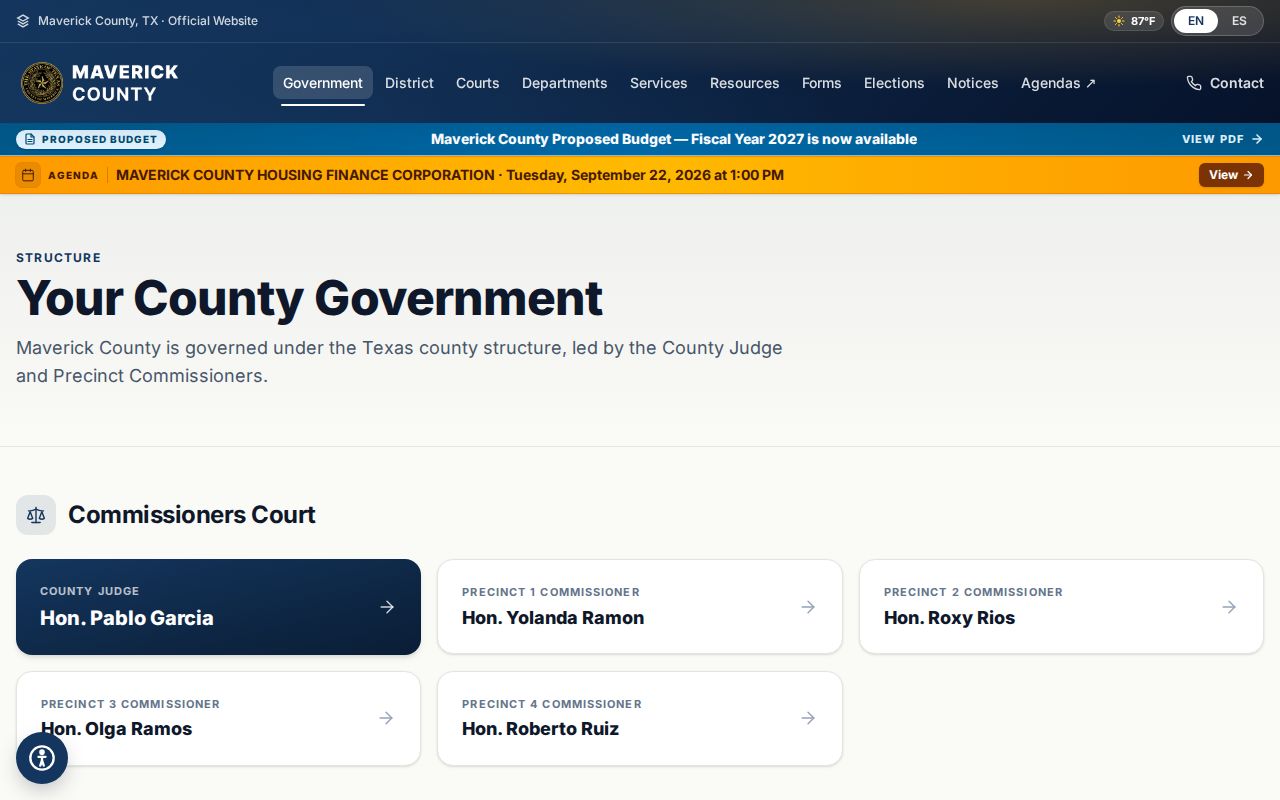
The Maverick County directory keeps its records offices apart from the sheriff and constables who may serve warrant papers.
Two District Courts Handle Felony Warrants
Maverick County felony cases sit in two different district courts. The 293rd Judicial District Court sits at 500 Quarry Street, Suite 4, and answers at 830-468-6850. The 365th Judicial District Court works from 501 East Main Street, reachable at 830-773-1151. Family and juvenile files also run through district-level contacts, so a JP traffic question never belongs with a district coordinator. The District Clerk, in Suite 5, can pull records but cannot tell you which judge holds the case. Neither district judge handles every county warrant. The county's official contact directory also keeps the County Clerk and District Clerk apart, with County Court questions routed to 830-773-3824 or the County Clerk at 830-206-8292. Which door you use depends on the file, not on one county warrant counter. The official court directory names both district courts and their current public contacts.
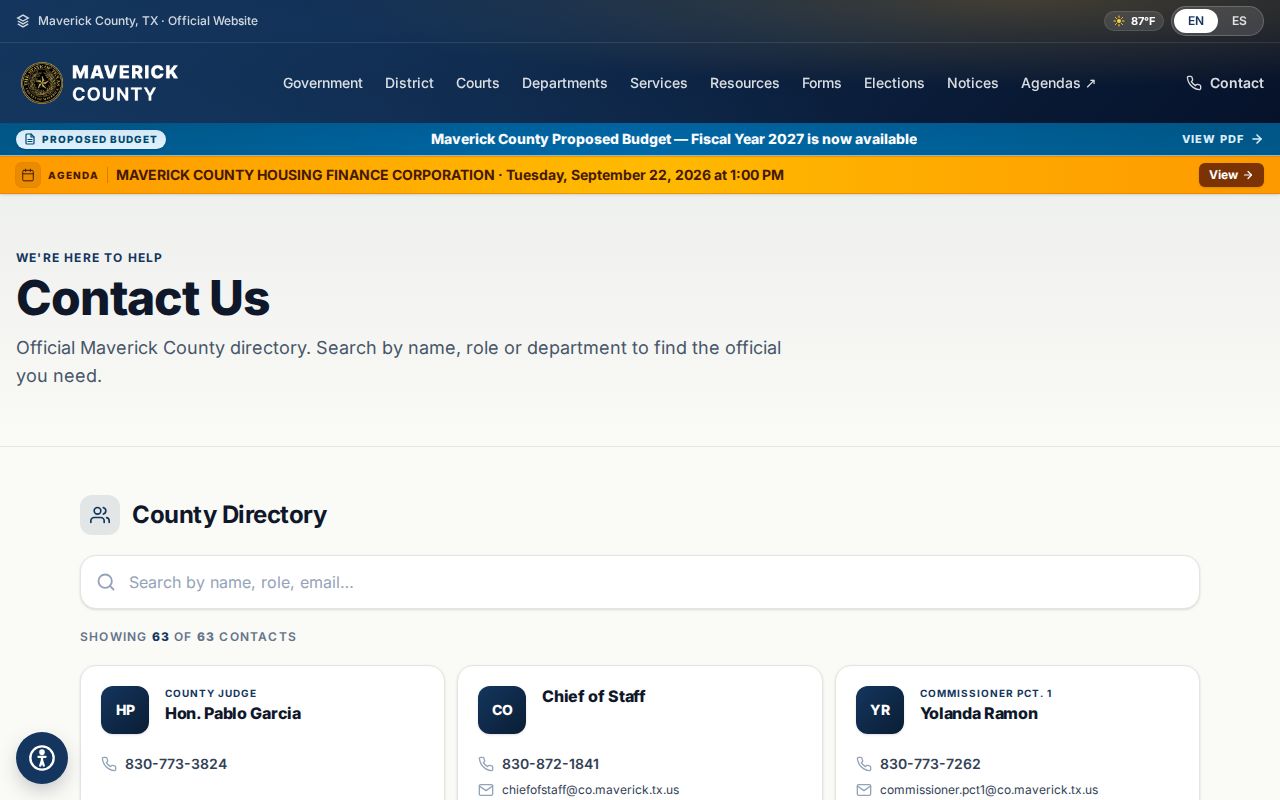
That directory confirms it: Maverick County court choice depends on the file, not on a single warrant counter.
If You Have a Warrant in Maverick County
Call the issuing court first. Before you drive anywhere or hand over money, ask what kind of warrant it is, whether you can appear voluntarily, whether a lawyer can arrange a walk-through, and what bond or payment the court allows. Maverick County publishes no bond schedule, jail bond-window hours, or surrender form. Every one of those answers lives with the court.
Get court instructions before going. Confirm the holding agency, appearance plan, and bond terms with the issuing court or an attorney.
Paying or posting bond settles custody or a fine, not the case itself. Get a receipt or court order, ask whether a new setting remains, and confirm the court reported any FTA/FTP clearance. Handling a Maverick County bench warrant works the same way. The issuing court controls each step.
Payment Does Not Confirm Warrant Recall
Maverick County's website sends each JP precinct to its own payment portal, and the county accepts credit and debit cards for those online services. A vendor receipt only proves a transaction. It does not prove a judge withdrew the warrant. On a JP fine, ask the clerk whether a balance, a court appearance, a payment plan, or a hardship review is still open. Eagle Pass takes online fine payments for city citations, but it publishes no blanket rule that payment recalls a warrant. Only the issuing court can answer that. The county services page links the county's five JP payment routes, and the selector helps you find your precinct's path. The clerk still holds the warrant status.
Maverick County Warrant Records and Public Access
Texas public access covers specific records, not a promise that every warrant appears online. Maverick County handles requests under the Texas Public Information Act. Arrest warrants and supporting affidavits carry a public-access rule, though other laws can limit release.
Relevant Texas rules:
Government Code Chapter 552 covers public information and allows specific law-enforcement exceptions, including §552.108 in qualifying cases.
Code of Criminal Procedure Article 15.26 addresses public inspection of arrest warrants and supporting affidavits.
Family Code §58.010 keeps juvenile arrest warrants and supporting papers confidential, subject to stated exceptions.
Texas Judicial Branch guidance explains how Article 15.26 interacts with judicial-record access rules.
Ask for the exact file. When the county or court withholds part of a record, ask it to name the legal basis. A public records rule never creates a public warrant roster, and the statute source backs a precise request plus a clear explanation of any exception.
Why No Online Result Is Incomplete
Maverick County posts no countywide active-warrant list and no most-wanted roster. A blank result from the Eagle Pass portal only speaks to that city's citation records. A JP case may sit in a separate precinct file. A felony case may rest with the district court or an agency serving the warrant. Juvenile records stay confidential, active investigations may be excepted from release, and fresh court action may not have reached every system yet. A payment receipt, an FTA screen, or a non-result proves nothing about warrant process ending. Only the issuing court can confirm the warrant and any next appearance.
DPS FTA/FTP Holds Are Not Warrant Searches
DPS's Failure to Appear/Failure to Pay program tracks reported traffic-citation compliance for driver records. A hold or screen is not a warrant search, and DPS staff cannot confirm a court's warrant status. After a court reports compliance, a driver record may need three to five business days to update. That window is not a recall deadline. Ask the reporting JP or Eagle Pass Municipal Court about its own case. The DPS FTA/FTP page explains the driver's-license compliance program and sends case questions back to the court.
Maverick County Warrants by City
Eagle Pass is the only incorporated city in Maverick County with its own documented municipal court and police department, and its 2020 Census population was 28,130. El Indio and Quemado are named county communities without separate city-court profiles. Quemado is served through JP Precinct 3 Place 2. City citations and ordinance cases belong to Eagle Pass Municipal Court. Use the city court route when the ticket names that court. Reach for the sheriff or a county court only when the record points to that separate layer.
Eagle Pass Warrant Records
28,130 residents in the 2020 Census; city police and Municipal Court handle distinct city records.